
VLP -like
The immune system responds far more strongly to an antigen presented many times on a small particle than to the same antigen in solution. The hard part is getting your antigen onto a particle, folded, soluble, and in a controled number of copies.
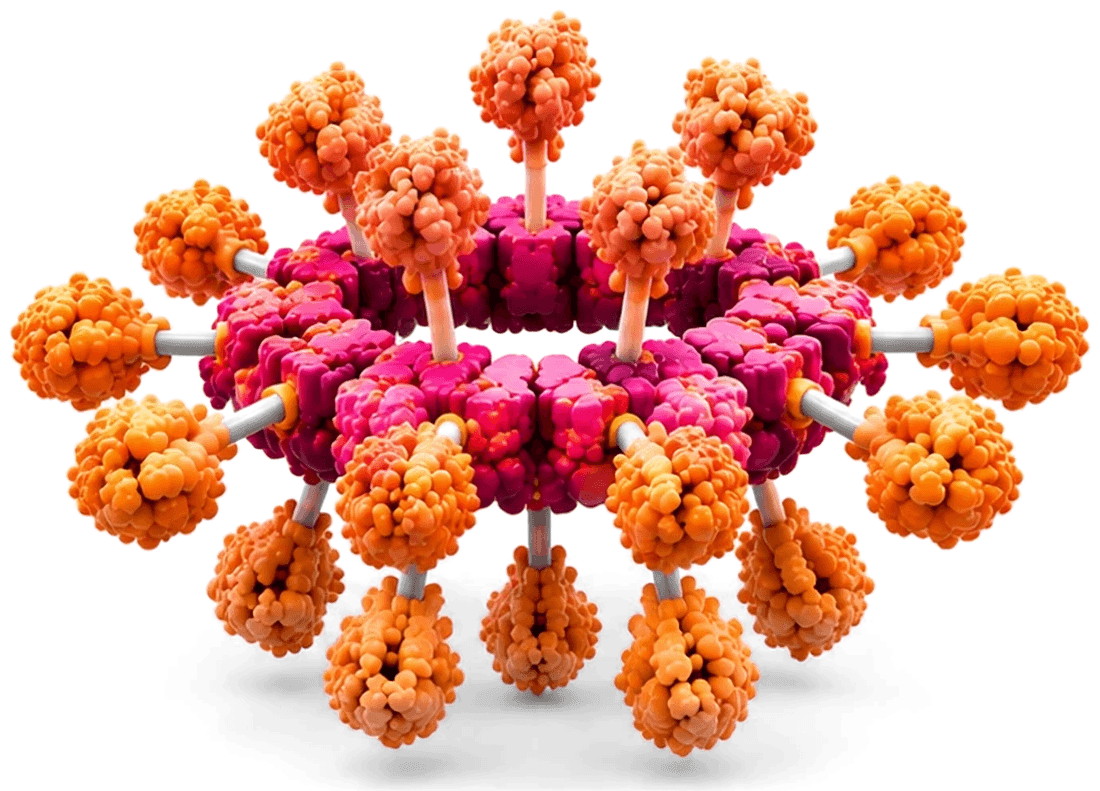
Up to twenty antigen copies on one ring
Where current approaches fall short
Conventional methods may offer limited control over antigen density and spacing, potentially reducing simultaneous binding interactions and avidity.Impact: suboptimal engagement of antibodies or receptors, potentially limiting avidity.
Random immobilization can mask key epitopes or reduce their accessibility to antibodies.Impact: epitopes may be less accessible to antibodies or immune receptors.
Combining multiple antigens at defined ratios can require complex engineering or conjugation strategies.Impact: difficulties in combining multiple antigens within one construct.
What the scaffold changes
Ten identical subunits enable consistent display of 10 or 20 antigen copies on a robust, particulate-sized scaffold. When genetically fused to the scaffold, antigens may benefit from improved solubility and folding, even when they are otherwise difficult to express. Production and purification can be completed in weeks rather than months.
Up to 20 antigen copies per ring, enabling control over copy number and spatial presentation.
Difficult antigens become expressible and handleable when genetically fused to our scaffold.
Adapt the number and combination of displayed antigens to the requirements of the target application.
Orientation and spacing set at the molecular level, not left to chance. Flexible loading depending on the protein display strategy.
Where it pays off
Stalled antigens programmes
Overcoming expression and solubility challenges that prevent development from progressing.
Antigen presentation studies
Comparing valency and spacing to isolate the effects of antigen presentation from those of the antigen itself.
Animal and veterinary health
Ideal for proof-of-concept development using bacterial production, enabling faster and more cost-effective manufacturing.
Validate your antigen in 8 weeks
You bring the antigen; we bring the scaffold. Together, we assess its expression, folding, and display potential within a clearly defined scope agreed upfront and under NDA.
Published evidence
Independent work, from other groups, on the value of multivalent and modular antigen display.
Displaying haemagglutinin on a self-assembling protein nanoparticle produced broader and more potent immunity than a licensed influenza vaccine.
Establishes why genetic fusion and chemical modification so often break assembly or folding, and how covalent plug-and-display coupling gets around it.
Reviews protein-based nanoparticle platforms for multivalent antigen presentation, highlighting how repetitive antigen display can enhance B-cell activation, antigen uptake, and immune responses. Discusses genetic fusion, chemical conjugation, and tag-based coupling strategies, providing a useful framework for designing scaffold-based vaccine platforms.
Stuck on a biomedical project? Bring it to us.
Under NDA, we assess whether probe or ligand scaffolding could overcome your project’s bottlenecks. If scaffolding isn’t the right solution, we’ll tell you upfront.