
Diagnostics
Most sensitivity gains in an immunoassay are bought with new instruments, new consumables and a new validation campaign. We work one layer lower, on the conjugate itself, so the assay, the analyser and the workflow stay where they are.
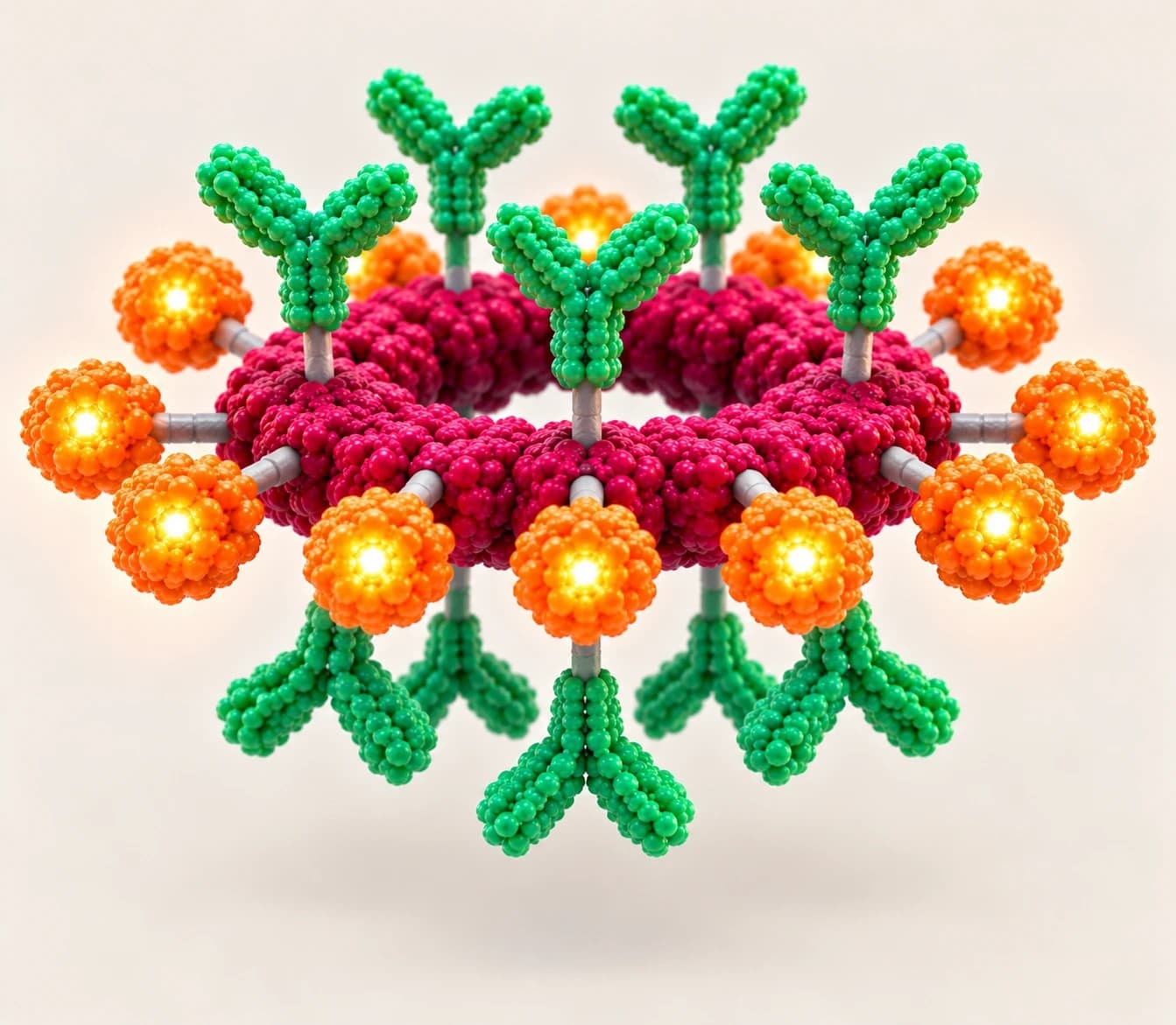
Binder and reporter, on one ring
Where current approaches fall short
Conventional diagnostic reagents may provide limited signal amplification per target-binding event, particularly when only a few reporter molecules are associated with each binder.Impact: reduced sensitivity and limited detection of low-abundance targets.
Conventional conjugation approaches can offer limited control over the number, spacing, and relative positioning of binders and reporters.Impact: variable binding performance, signal output, and assay reproducibility.
Combining target recognition and signal generation often requires extensive optimisation of component ratios, coupling conditions, and reagent formulation.Impact: longer development cycles, batch variability, and increased manufacturing complexity.
A more sensitive platform means new hardware in every lab. A better reagent means a new lot number.
What the scaffold changes
The PRX ring provides a modular architecture for co-displaying binders and reporter molecules on a single scaffold. Its distinct display positions allow the two functions to be organised separately, with component loading and attachment strategies adapted to the requirements of each diagnostic application.
Display multiple binders on one scaffold to promote avidity and target retention.
Co-localise multiple reporters with the target-binding component to increase the signal generated per captured target, depending on the reporter system.
Define component number, composition, and spatial arrangement through the scaffold architecture and the selected display strategy.
Combine genetic fusion, adapter–ligand binding, or chemical cross-linking to accommodate different binders, reporters, and assay requirements.
Develop new reagent formats with the potential to improve assay performance while retaining existing instrumentation and protocols, where compatibility permits.
From Conventional Conjugates to Multivalent Diagnostic Reagents
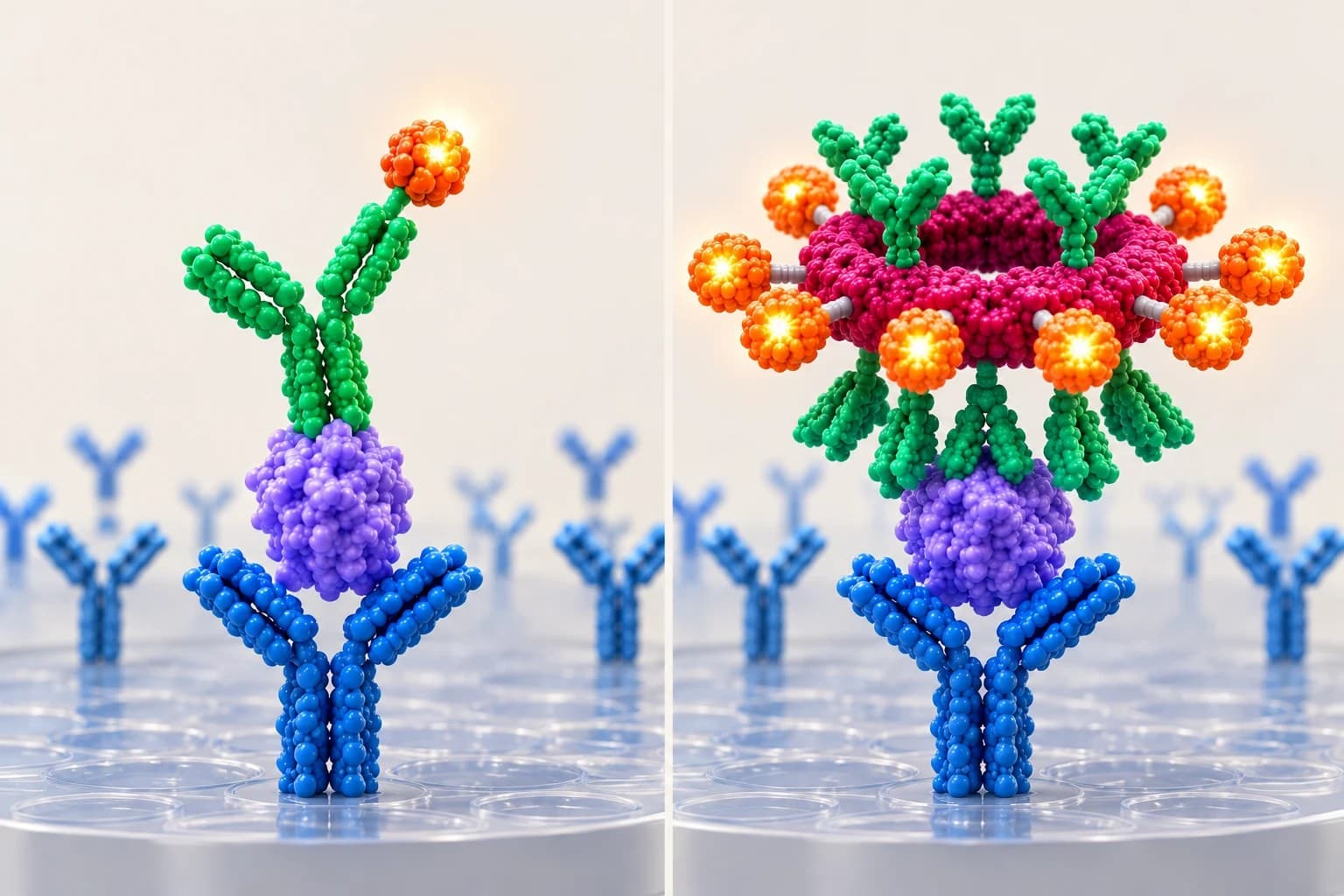
One binder, one reporter: limited signal generated per binding event.
Multiple binders support multivalent target capture, while multiple reporters increase signal potential per binding event. One sharper reagent.
Formats covered
ELISA
Replace the conventional detection conjugate, or scaffold both capture and detection reagents to explore further performance gains.
Immuno-PCR
Display a defined number of DNA reporters per binding event to support controlled signal amplification.
Flow cytometry
Develop higher-signal reagents for low-abundance targets, designed for use with existing instruments.
Lateral flow
Increase signal intensity at the test line while retaining the existing strip architecture, subject to assay compatibility.
A 12-week feasibility on a single analyte
One analyte, one design iteration, and a head-to-head benchmark against your current conjugate, with acceptance criteria defined upfront. Success means improved analytical performance while maintaining blank performance: not simply generating a stronger signal.
Published evidence
Independent studies from other research groups supporting the scientific principles of multivalency and reporter amplification in immunoassays. These publications provide external evidence for the underlying concepts
A 14-valent display built on a heptameric protein scaffold improved antigen capture more than tenfold in magnetic bead and ELISA formats, the closest published analogue to our approach.
Demonstrates how protein scaffolds displaying multiple reporter enzymes can enhance assay sensitivity. Multivalent NanoLuc display increased ELISA detection sensitivity by approximately 10-fold compared with the monomeric reporter, highlighting the potential of scaffold-based signal amplification in diagnostics.
Stuck on a diagnostic project? Bring it to us.
We assess, under NDA, whether probe or ligand scaffolding can fix what is holding your project. If it is not the lever you need, we will tell you plainly.