
Biocatalysis
Our scaffold gathers up to twenty copies of one enzyme, or of several, on a single ring, each oriented and spaced by design. The result: higher activity, better stability and cascades co-localized at a defined ratio, free in solution or on the carrier you already use.
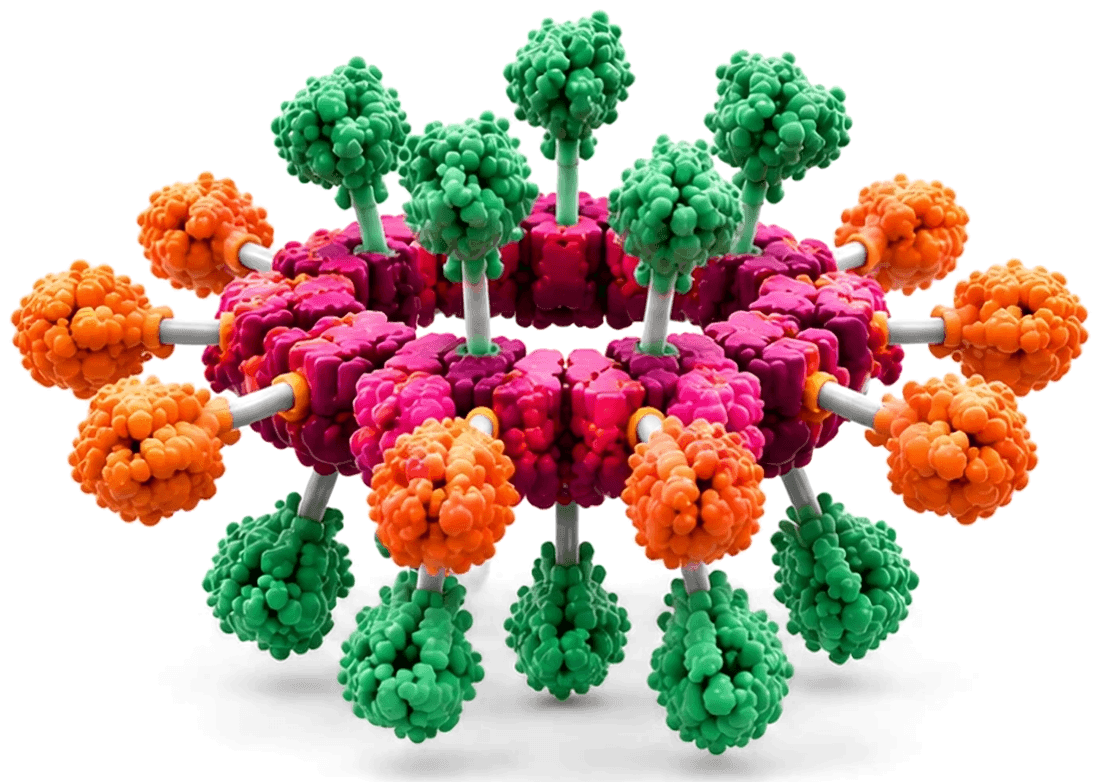
Up to twenty enzyme copies on one ring
Where current approaches fall short
Hard to isolate and recycle. In cascades, intermediates diffuse away before reaching the next enzyme, and free enzymes are often less stable.Impact: enzyme used up with every batch, activity lost over time, lower yield.
Recoverable, reusable and often more stable, but orientation and spacing are poorly controlled, and activity loss, diffusion limits and leaching are common.Impact: innert carrier mass, immobilization cost, activity underused.
Substrate is diverted to the host’s metabolism, toxicity limits conversion, and cell survival constrains reaction conditions.Impact: more substrate per kilogram of product, and less room to optimize the process.
What the scaffold changes
Each ring carries up to twenty enzymes, with number, orientation and spacing set by design. The result: higher activity and better stability. The ring’s size also makes the enzyme easy to isolate and recycle, with no carrier at all. If your process already runs on resin, the same ring couples to it, and each unit of resin surface carries more active enzyme.
x 2.5 at equal enzyme quantity, on two unreleated wild-type enzymes.
Activity retained longer than with the free enzyme (lipase).
Orientation and spacing set at the molecular level, not left to chance. Flexible loading depending on the protein display strategy.
Easy to isolate by size without requiring a carrier, while remaining compatible with your existing resin for immobilization when needed.
Several enzymes per ring, at a defined ratio and distance, to tune synergies and flux.
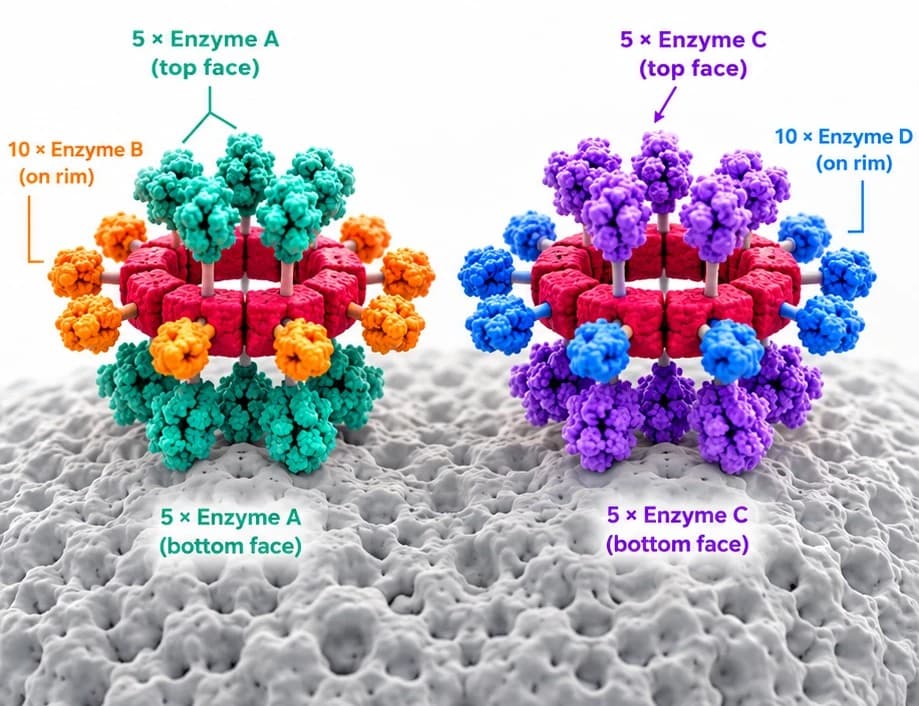
Organizing a four-enzyme cascade with the PRX scaffold
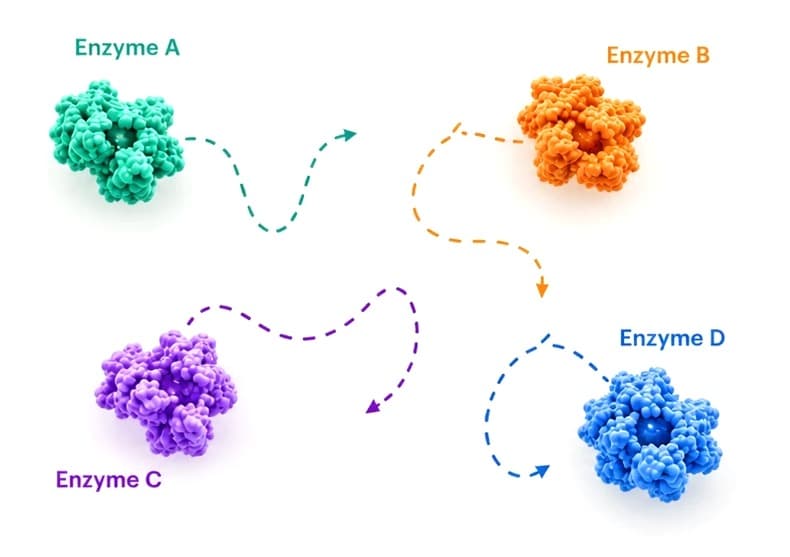
Intermediates diffuse away, limiting transfer to the next enzyme.
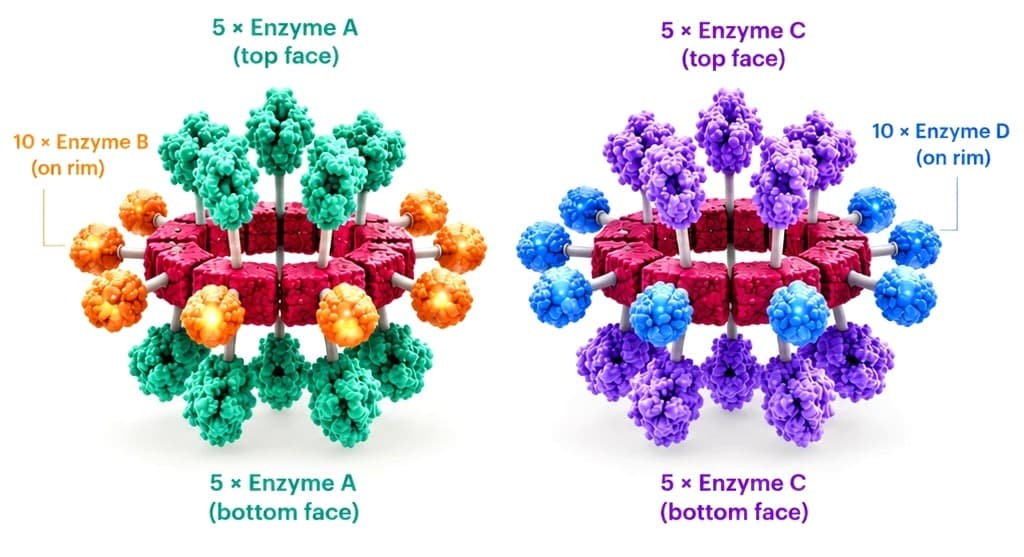
Intermediates reach the next enzyme through spatial proximity.
Disordered, randomly mixed and sterically hindered.
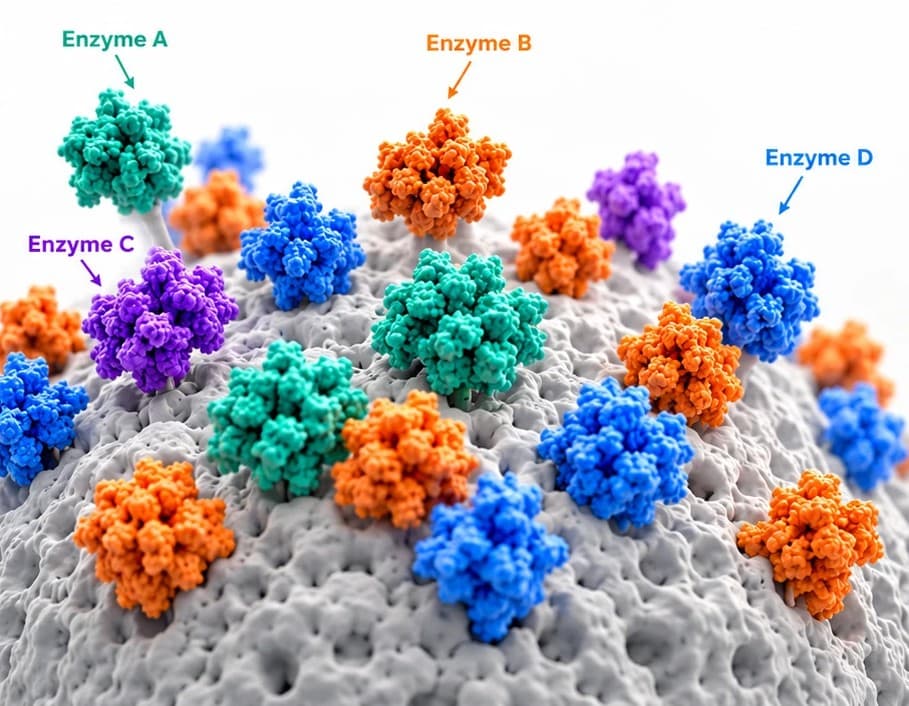
Organized, accessible and co-localized.
Measured in our lab
Our own results, on model enzymes. Two unrelated enzymes, one factor: the gain does not appear to depend on one particular enzyme. Activity is compared with the free enzyme at equal enzyme quantity. Full protocols and raw data are available under NDA.
2.5× higher activity of scaffold-displayed enzymes compared with their free counterparts under identical conditions, demonstrated with two enzymes from unrelated families and with distinct catalytic mechanisms.
The displayed lipase also held its activity longer than the free enzyme under the same conditions.
Already immobilizing? Get more from every surface.
Recovering a scaffolded enzyme by size is one option, not the only one. If your plant runs on a packed bed or stirred reactor with a solid carrier, the scaffold binds to resin using standard immobilization chemistry, and the ring’s built-in organization makes that immobilization more effective. We help you choose the right support.
More active sites per anchor point
One attachment point brings up to twenty enzyme copies instead of one, so the same resin surface carries much more catalytic capacity.
Structural control for better immobilization
Sitting between resin and enzyme, the scaffold sets how many enzymes are loaded and how they are oriented and spaced.
Your process, unchanged
Packed bed, stirred tank, membrane reactor or free in solution: the same scaffolded enzyme fits all four, so you keep the format your plant already runs.
Where the business case is strongest
Costly substrates
When raw material dominates the cost, every point of conversion saved money.
Costly enzymes
When every gram of rare or hard-to-make enzymes is recovered and delivers more product, the biocatalytic process becomes viable : higher activity, better stability, more cycles.
Inefficient cascades
When intermediates are labile or toxic, or cofactors must be recycled, co-localizing the enzymes on one scaffold keeps intermediates at high local concentration, raising throughput and steering flux toward the product.
Natural vanillin, from ferulic acid
A single enzymatic step from biobased ferulic acid: a cell-free process developed with an industrial partner.
In the literature
Independent work from other groups on the principles behind our approach: spatial clustering, architectural control and multivalency.
Demonstrates how programmable protein scaffolds can precisely organize enzymes in a cascade, improving proximity, stability, and reusability. Co-immobilization of PETase and MHETase enhanced thermal stability and increased product yield, highlighting the potential of protein scaffolds for efficient and reusable biocatalysis.
Protein scaffold design for multienzyme complexes, emphasizing control of inter-enzyme distance, stoichiometry, and in vitro applicability. Modular tags such as SpyTag/SpyCatcher and cohesin-dockerin build defined complexes in vitro, favoring substrate channeling and protecting labile or toxic intermediates.
Reviews cell-free metabolic engineering. Artificial scaffolds improve cascade efficiency by reducing diffusion, decomposition, and loss of intermediates; protein-protein scaffolds being one of the main design modes.
Demonstrates how a self-assembling protein scaffold can organize enzymes into higher-order structures, enhancing catalytic activity and stability. Direct scaffold–enzyme fusion increased activity while overcoming the stability–activity trade-off of an industrial enzyme, highlighting the potential of protein scaffolds for robust biocatalysis.
Stuck on a biocatlytic route? Bring it to us.
We assess, under NDA, whether enzyme scaffolding can fix what is holding your biocatalytic route back. If it is not the lever you need, we will tell you plainly.