
Peptides
Peptides are attractive but hard to deploy. Whether synthetic or natural, a peptide often works well on the bench and disappoints in use: too fragile, too weakly bound, too poorly produced, too expensive to synthesize at scale. Displaying it in multiple copies on a protein scaffold can address these limits together.
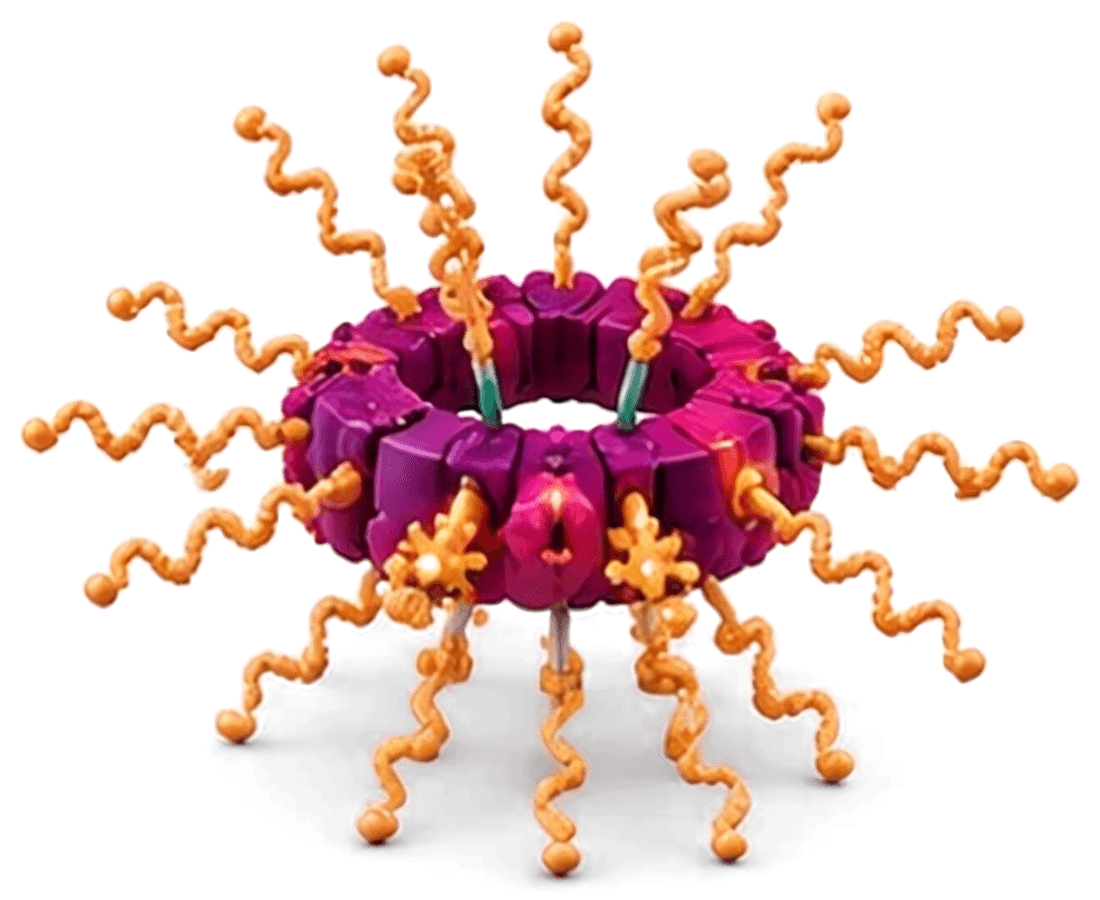
Up to twenty peptide copies on one ring
Where current approaches fall short
A single peptide may bind its target with modest affinity, making the interaction vulnerable to dissociation.
Free peptides can aggregate, degrade, or lose functionality in complex matrices, formulations, or field applications.
Chemical synthesis sets a floor on the cost per gram that many applications cannot absorb.
Two routes, depending on your peptide
Synthetic peptide: grafted in vitro.
The peptide is made by chemical synthesis, including non-natural residues or modifications, then coupled to the pre-assembled ring. The scaffold stays a recombinant protein, and the peptide load is set at the coupling step.
Natural peptide: fused genetically.
The peptide sequence is fused to the subunit gene, so the ring and its peptide load are produced together by fermentation. No coupling step is needed, and the fusion is expected to improve solubility and stability.
Active or not.
The scaffold serves two kinds of peptide. An active peptide acts on its target itself, for example as a binder, inhibitor or antimicrobial, and avidity and stability drive its performance. A non-active peptide only addresses the object to a target or gets the object recognized, as a targeting ligand, a capture tag or an epitope. Here the scaffold's job is to present many copies at the right spacing, so that the object finds and holds its target. The synthetic and natural routes above apply to both.
What the scaffold changes
Display up to 20 peptide copies at defined spacing on a single scaffold. Multivalent interactions can strengthen target binding, while the protein framework can support peptide stability and solubility. For suitable natural peptides, genetic fusion enables production of the entire construct as a single recombinant protein overcoming solubility and expression limitations, simplifying manufacturing.
Multiple copies enable simultaneous interactions with the target, potentially strengthening binding where a single peptide interaction is insufficient.
Scaffold display can help protect peptides from degradation and support their structural integrity.
For aggregation-prone peptides, genetic fusion to the soluble scaffold can improve solubility and facilitate recombinant production.
In the literature
Independent work from other groups describes the principles our scaffolding approach relies on.
A weakly active peptide displayed on a protein scaffold outperformed both its free form and standard antibiotics against several strains, while remaining non-haemolytic.
Two to eight times more activity from multivalent versions, alongside a clear caution: preassembly also raised activity on human cells, so geometry has to be designed, not assumed.
You bring the peptide. We bring the scaffold.
Tell us about your target peptide and application. We’ll assess whether PRX scaffolding could improve its binding, stability, solubility, or production.